Showing posts with label review. Show all posts

Saturday, August 7, 2010

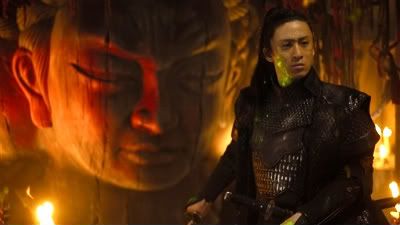
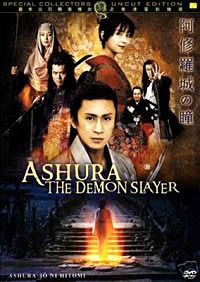
Movie Review: Ashura


Ashura-jo no Hitomi

“Ashura,” aka “Blood Gets in Your Eyes”

Japan, 2005

Genre: Action, Fantasy

119 minutes

http://www.imdb.com/title/tt0459744/

Based on a modern kabuki stage play, Ashura is a tale of romance, treachery, and violence. It is a tale about a demon-slayer who runs from his past, only to discover that it has all caught up with him.

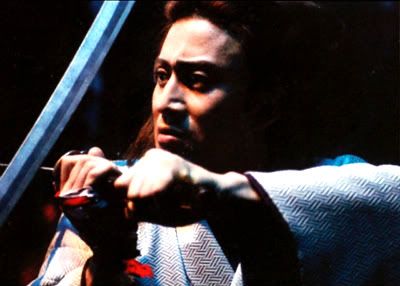
Yojiro Takita directs this adaptation of the hit kabuki play, closely following the original story in the film. This works both for and against him at times, which begs the question of his intent for the adaptation. Driven by very beautiful sets and an outstanding score, the actual performances on screen are hammed to a point of absurdity. I imagine that Takita was looking for a larger-than-life story of epic proportions, but the result ends up feeling forced. The characters are written to have depth and sympathy, but end up sounding completely different from one scene to the next, lacking a basic consistency of personality that allows the audience to identify with them. Somegoro Ichikawa’s hero is genuinely charming at times, but overall feels like he’s just playing a cardboard cutout of a heroic stereotype. While such performances might work on stage (especially kabuki, which is generally highly stylized), the film adaptation makes it more cheesy than symbolic.

The production of the film is certainly impressive. As mentioned, the soundtrack is superb, adding life to many scenes that would otherwise have no redeeming value. The sets reveal rather clearly the stage roots of the piece, but this itself is not a fault. Many successful films make use of stylized sets or stage-style locations. However, it should be noted that the decision to do so makes the film feel very cramped, even when using exterior shots. It lacks the sense of wonder or majesty that can really only be achieved by shooting on location. Ashura also makes liberal use of digital effects to reinforce the supernatural fantasy aspects of the story. Stage performances make do with practical effects, and maintain a sense of illusion when doing so. Films, on the other hand, lose that quality with computer-generated imagery, especially with the over-the-top style used by this movie. The monsters seem intentionally fake and cartoonish, spewing fluorescent green blood upon their death. Marching forward with all the subtlety of neon rhinoceros, the look of the film is excessive and gaudy.

Selling itself as a swashbuckling adventure, the film’s fight scenes aren’t terribly done, especially when compared to other Japanese action movies like High-Kick Girl or Shinobi. Still, when looking at the fast-paced and hard-hitting choreography coming from countries from around the world, the fights feel stiff and awkward. Like the rest of the film, Ashura chooses style over substance, leaving the audience with a product indistinguishable from the sea of other C-list action movies in the video store.

Friday, July 30, 2010

Movie Review: Spin Kick

Dolryeochagi

“Spin Kick,” aka “Taekwon Boys”

Korea, 2004

Genre: High School, Sports

102 minutes

http://www.imdb.com/title/tt0406713/

After beating up their high school Taekwondo team, two young troublemakers are forced to join the team in order to make amends.

Spin Kick, for better or worse, plays like a very typical sports movie. From the rag-tag team of unlikely heroes, to the fallen coach, to the squeaky clean rival school champions, the only thing that sets the film apart from every other sports movie ever made is that it features Taekwondo. Starring Korean pop-idol Dong-wan Kim, Spin Kick is shallow and formulaic, but manages to entertain regardless.

The film is well-made, with high production quality probably supported by the South Korean government for the purposes of promoting Taekwondo in the media. The cinematography isn’t particularly inventive, or is the score very compelling. It is an average production, in every sense of the word. Dong-wan Kim gives a pretty good performance throughout, but most of his co-stars remain static and uninteresting. The exceptions that must be noted, however, are the Coach and best friend, both of whom deliver a strong range of emotion with very solid readings.

The story, as mentioned, is more or less a re-hash of every underdog sports narrative ever done. The high school’s long history of Taekwondo success has fallen flat, and somehow requires the combined talents of misfit punks, a failed coach, and spunky spirit to revitalize the program. They magically win the championship tournament against the better funded, better trained, and better organized favorites, proving once again that heart is an able substitute for a lifetime of training. I would apologize for spoiling the film, but it’s really a story we’ve all seen a hundred times before. The characters are introduced and fail because they don’t get along, then there’s a magic training montage, then tragedy strikes, then they overcome adversity and triumph. It’s a good formula, and has served movies well from the Mighty Ducks to Remember the Titans. As much as I want to dislike this film for having such a contrived and unoriginal plot, it’s hard to find faults beyond that. It’s funny and entertaining, and because I have a very cursory knowledge of Taekwondo as a sport, it’s hard to know how accurate their portrayal of it is. The fight scenes look authentic with the exception of some rather obvious wire-work, and wraps together as a pretty satisfactory package.

It’s not anything special, but it’s not a boring film. If you have any interest in Taekwondo or Dong-wan Kim, it’s worth checking out. It certainly won’t be winning any awards, but as far as a popcorn movies go, it does what it sets out to do.

Friday, July 23, 2010

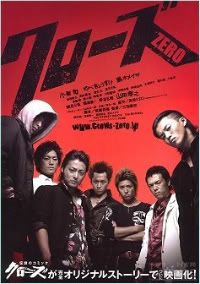
Movie Review: Crows Zero


Crows Zero

Japan, 2007

Genre: Gangster, High School

130 minutes

http://www.imdb.com/title/tt1016290/

A prequel to the manga series by Hiroshi Takahashi, Takashi Miike directs the origins of Genji’s rise to power in the ultra-violent Suzuran All-Boys High School.

In the chaotic world of Takashi’s Suzuran, a student’s worth is proved by his fists and his gang. Our protagonist, Takiya Genji, transfers to the high school in hopes of conquering it, a feat his yakuza father was unable to do decades ago. Like other yakuza and criminal films, Miike touches on themes of friendship and loyalty, the bonds between men forged in battle, and the respect given to leaders who show their strength to their followers. While the writing is rather contrived in places (in particular the repeated use of a love interest as a convenient plot point), the actors open up the space and bring the audience into the story very well. While switching back and forth between adolescent humor and dramatic tension, the cast is guilty of hamming it up in places, but it mostly goes unnoticed.

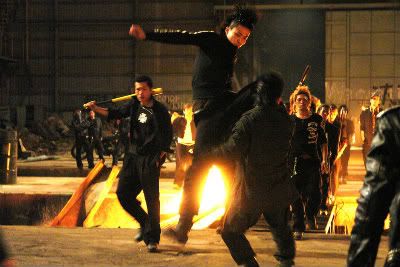
The photography of the film isn’t particularly outstanding, although there are a few truly iconic scenes. Miike does manage to capture the epic atmosphere demanded by the story, and yet keeps the camera relatively grounded, gritty enough to embrace the visceral nature of the subject matter. This works against the audience in some of the action sequences, which can become confusing before identifying characteristics are clear to the viewer. Even at the end of the film, when we’re aware of who is beating up whom (generally given away by their outlandish hairstyles), faces and identities get lost in the shuffle. Although not usually vital to understanding the story by the end, enthusiasts of fights on film may have a hard time of enjoying these pieces.

The action itself is superb, and the cinematography doesn’t always do it justice. Bordering between brutal realism and cartoonish violence, the comic book roots are clearly evident. The choreography is simple and direct; expect lots of haymakers and straight knees to the midsection. With the addition of the flashy kick or pro-wrestling throw here and there, the result ends up looking very much like a manga about violent teenagers in a comic book scrap. While not particularly elegant or fantastic like the Hong Kong style of fight scenes, Crows Zero has its own rather pleasing aesthetic, thanks in part to very impressive editing and scoring. The climax of the film shifts moods dynamically, but it fits so well that it’s almost unnoticeable.

Having never read the Crows manga, I can’t say for certain how accurate an adaptation Miike produced. However, as a piece of film on its own merits, I can say that Crows Zero is a very fun movie for comic book violence.


Friday, July 16, 2010

Movie Review: Blood on the Sun

Blood on the Sun

USA, 1945

Genre: Noir, Political Thriller

98 minutes

http://www.imdb.com/title/tt0037547/

James Cagney stars as a tough newspaper editor in Imperial Japan, bent on uncovering a conspiracy within the Japanese government for world conquest.

Blood on the Sun is a forgotten classic from a bygone age, and a must-see for any fan of film noir. They really don’t make films like this one any more, which is unfortunate. Times were different back then, when you needed more than just a camera and some friends to put a movie together. With brilliant photography and sharp dialogue, Blood on the Sun is a fine example of the genre. However, to be totally fair, this was also an era before feminism or any kind of political correctness. Villains portrayed in yellow-face with ludicrously forced accents are definitely noticeable and a little difficult to watch in the modern age. Although based on historical events and documents (which they themselves are questionable), one wonders just how accurate the portrayal of Japanese culture is in this wartime film.

Social issues aside, Blood on the Sun is superbly produced, even winning the Oscar for Best Art Direction. The use of lighting for dramatic effect is stunning, and the score, while not exceptional, fits as a product of the time period. Cagney is fantastic in the leading role, exemplifying the Tough Guy role he was known for. He plays an idealized American male, rough and brash, but always sound in his judgment and his principles. Silvia Sidney’s role of the leading lady is melodramatic at times, but otherwise satisfactory for the character as written. As mentioned, don’t expect much in terms of the modern feminism in this movie. The villains of the tale, led by John Emery and Robert Armstrong, deliver the poorest performances of the film, mostly due to their failure to produce a believable Japanese accent.

Impressively, Cagney insisted on doing his own stunt work for the film, and studied judo extensively under John Halloran, an officer with the LAPD, and Ken Kuniyuki, a leading sensei in the Southern California area. While fight choreography has definitely progressed a long way from the 1940s, the action is still impressive as one of the earliest martial arts movies in history, and probably the first to show judo to Americans. Cagney’s judo skills were strong, and he demonstrated it to great effect in the film’s fight scenes. He has even been quoted as saying he loved judo so much that he continued to practice it long after the production was finished.

While carrying of the social baggage that comes with aging for 65 years, Blood on the Sun is still a great film even today, and worth watching as both a piece of history and just a fun popcorn movie.

Friday, July 9, 2010

Movie Review: Fatal Deviation

Fatal Deviation

Ireland, 1998

Genre: Action, Tournament

90 minutes

http://www.imdb.com/title/tt0488046/


After ten years away from his home, a fighter returns to learn the truth about his father and win an ancient fighting tournament.

This is one of those movies you hear about on the internet being so bad, so incompetent, so hilariously put together that you think there’s no way it could be as bad as advertised. So while I could just point you to the film on Youtube (conveniently uploaded in its entirety), I’m going to take this week to emphatically say that yes, it is in fact as bad as you think it is. It’s poorly shot, poorly acted, poorly edited; just about everything that can be done looks like it was done by someone with absolutely no idea how to perform their craft. As a study of film production, it works perfectly as a “What Not to Do” film.

James Bennet writes, produces, casts, shoots, and stars in what is a typical case of martial arts egomania. Like so many C-movies before him, Bennet becomes convinced that because he has trained in martial arts, he is somehow qualified to become a film-maker, using what limited resources at his disposal to promote himself as the next action star. And like those before him, he ultimately fails in all aspects of the medium, becoming the subject of ridicule and cult-status for the absolute abomination he has created.

So what has he done wrong, really? He had a vision for a film to sell himself as a genuine actor and performer, and probably funded the project with a small group of friends, then managed to get it distributed by a small-time company. Respectable, right? Right. Still, that doesn’t mean that the acting wasn’t boring, the action haphazard, or that the plot wasn’t full of holes the size of Dublin. It only means that there was a reason behind the sloppy production of the film. Objectively speaking, the movie was terrible, and no amount of justification will change that. If you’re really interested in seeing just how bad the film is, you can find it online at the link below. But honestly, it’s really not worth it.

http://www.youtube.com/watch?v=uUHSCNMH4wE

Friday, July 2, 2010

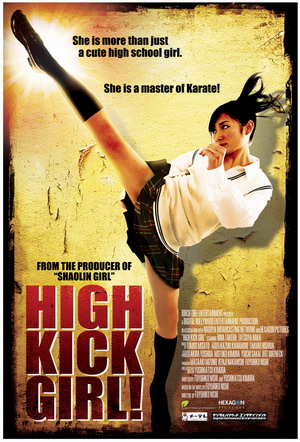
Movie Review: High-Kick Girl


High-Kick Girl

Japan, 2009

Genre: Action

81 minutes

http://www.imdb.com/title/tt1406157/

A high school girl training in karate seeks out stronger opponents to test her fighting skills on, only to become involved in a revenge plot by a gang of thugs against her master.

In addition to Hong Kong, Japan now faces stiff competition from Korea and Thailand when it comes to producing martial arts movies and martial arts superstars. High-Kick Girl introduces Rina Takeda, a young Japanese idol who holds a black belt in Ryukyu Shorin-Ryu Karate, hoping to develop her new film career into the next action franchise. However, with incredibly low standards of production quality going into this project, I would be surprised if anyone even bothers to learn the actress’s name, much less watch her next movie. With poor writing, bland performances, and altogether lackluster direction, High-Kick Girl is a boring, contrived, and visual mess, failing in just about every aspect of the genre and film-making as a whole.

The script’s pacing has no sense of drama or tension whatsoever, and none of the dialogue is captivating at all. We are thrust from one event to the next without any idea of who is important, what is happening, or why any of the characters are doing anything at all. Coupled with single-note performances by the entire cast, the movie drags on for the entire hour and twenty minutes that it spans. Normally, these sorts of things would be tolerable in an action movie, which provides the real entertainment in between the moments of bland plot forwarding. However, in the case of High-Kick Girl, the failures of production penetrate every level of the film, leaving nothing worth watching. With ridiculously excessive amounts of slow-motion, the camera work does nothing but emphasize the terrible choreography and execution by the stunt team. Often, they will repeat entire stunt sequences in slow-motion, using the exact same angle as we’ve just seen. This pointless gesture just pads the movie further and makes it obvious how little material the team actually had to work with. Removing all the slow motion and repeat cuts, the film as a whole would measure around an hour, if that.

Thematically, director/writer Fuyuhiko Nishi treads the same clichéd martial arts tropes of “self-defense and protection only” and “fighting is wrong, and is a last resort only.” However, without any affinity for the leading characters, the message falls flat and Takeda’s arc feels less like the development of self and more like an abrupt shift of personality compelled by the plot. Unless you have some massive fetish for Japanese school girls in action, there is absolutely nothing redeeming about this film. It is a disappointment as an action flic, fails as a plea for traditionalism, and lacks any impact as a cathartic work of art at all. If we are to see more of Takeda as a rising film star, hopefully it won’t be anywhere near Fuyuhiko or his team.

Friday, June 25, 2010

Movie Review: Born to Fight

Kerd Ma Lui

Thailand, 1984

Genre: Pulp Action

93 minutes

http://www.imdb.com/title/tt1566530/

Panna Rittikrai, the man behind Ong Bak and Tom Yum Goong, directs and stars in Born to Fight, one of his earliest films. A Hong Kong lawyer uncovers an embezzling plot and must flee to Thailand seeking protection from a fearsome gang of enforcers.

Marketed as the film inspiration for Tony Jaa’s own stunt career, Panna’s work is easily recognized in this piece of history. Panna himself was heavily influenced by the films of Bruce Lee and Jackie Chan, and numerous references to both action stars make their way into the movie (try counting how many times Panna swipes his nose). Still, this piece represents a landmark in the development of Thai action cinema, and pioneered many of the stunt techniques seen later in his films with Tony Jaa.

While the production quality is definitely reflective of the low budget and undeveloped photography skills, the movie is rather entertaining for what it had to work with. The acting is unsurprisingly wooden and melodramatic, but the dialogue is genuinely clever and humorous at times. Panna relies on a number of classic slapstick gags for comic relief, which doesn’t always feel appropriate for the moment, but the talents of his comedic co-star help sell the cheesiness of the jokes.

Like his protégé, Panna uses the film to demonstrate his numerous skills in stunt performance and choreography. Fast paced fight scenes and full-contact strikes became the cornerstones for his wild success with Ong Bak, and his use of a variety of martial arts styles would be seen again in Ong Bak 2. Leaps off cars, over dirt bikes, into flames, and through floorboards make up rest of the stunts and illustrate Panna’s still rough style of choreography.

While Born to Fight obviously can’t compare with the far more polished works made more than twenty years later, the movie is still very much worth checking out. Taken for the 70s era B-movie that it is, Panna directs a fun romp through rural Thailand, with spit-takes, motorbike chases, and fights against a team of ninjas. Choppy and clumsy at times, Born to Fight represents the first in an amazing legacy of hard-hitting Thai action films.

Friday, June 18, 2010

Movie Review: The Road Warrior

Mad Max 2: The Road Warrior

Australia, 1981

Genre: Action, Dystopia

95 minutes

http://www.imdb.com/title/tt0082694/

Mel Gibson stars as Max, the Road Warrior, in his breakout hit. A desolate man in a desolate world, Max finds himself between a roaming community harboring a fuel tanker and a vicious street gang that wants it.

While not my usual fare when it comes to fight films, The Road Warrior is an interesting take on the classic Western story of a town in danger and the lone rider that comes to their aid. However, instead of a strong and silent guardian of the weak, Max is only out for his own interests, and is more dragged along by the circumstances as they unfold. Even as the action builds to the final climax, he is revealed to be just a pawn in a much grander scheme. It’s refreshing to see a character so completely human, taking the lumps as they come and just making the best decisions available at the time.

The Road Warrior, without a doubt, is a landmark in post-apocalyptic fiction. With fantastically bizarre characters and world design, director George Miller’s vision of a leather-punk dystopia straddles the line between the macabre and comical. The predecessor of countless imitators and parodies, nothing is like witnessing the original in its entirety. The film itself can be difficult to follow at times, as the limited dialogue and intense action sequences often leave the viewer to figure things out for themselves. Luckily, the story and actors are strong enough to make it fairly easy to pick up the pieces as they fall. There are a few hiccups in performance throughout the movie, but for the most part the actors know what situations call to be nuanced and when to be extravagant.

Like the name implies, the heart and soul of the film lies in the thrilling action sequences, almost all of which take place as high speed pursuits on the open road, set against a gorgeous desert in the Australian outback. Without CGI or blue screen effects, the impact of real crashes and real explosions can be felt in your very bones. Heart-pounding and hard hitting, the intensity of each scene only builds the movie higher and higher. Opening with small, isolated skirmishes at the start, the film moves onward and upward to a full-scale siege and a hell-or-highwater chase sequence in an armored Mack truck. Even thirty years after its release, it still holds up as a fast and furious action flick by today’s standards. Brutally fun, graphically intense, and energetically strange, it’s no wonder that The Road Warrior remains one of the best cult classics of all time.

Wednesday, June 16, 2010

Strikeforce: Los Angeles Quotes of the Night

"That grazed the chinny chin chin!" -M. Ranallo

"They also say never hook with a hooker, right?" -S. Quadros

"Is his English good or what?" -M. Ranallo

"Cyborg drops him like names at a hollywood party!" -M. Ranallo

"We're in Los Angeles, maybe he's auditioning!" -M. Ranallo
"I've been in a movie with Robbie, he's not that good." -P. Militich

Monday, June 14, 2010

UFC 115: Catch The Hat Thief!


There's been a disturbing trend growing in MMA where fans steal a fighter's hat as they walk to the cage. This is low, really really low. Fighters probably get sponsorship deals from those hats, and by stealing them, you are effectively stealing part of their paycheck.

This stops here.

MiddleEasy has post up these animated GIFs from UFC 115 this past weekend, where the thieves can be seen in the act. If anyone recognizes these guys, let's track them down and bring them to justice!

GIF 1

GIF 2

GIF 3

Here are close-up stills of the perpetrators. The man who steals Ben Rothwell's beanie may or may not be the same guy waving his arms in GIFs 1 and 3, but he looks pretty similar.

STILL 1

STILL 2

STILL 3

STILL 4


Together, I know we can nab these guys!

[Source: http://middleeasy.com/index.php?option=com_content&view=article&id=2379]

Friday, June 11, 2010

Movie Review: Flash Point

Dou Fo Sin

“Flash Point” or “City With No Mercy”

Hong Kong, 2007

Genre: Crime Drama

88 minutes

http://www.imdb.com/title/tt0992911/

Donnie Yen returns as a hard-nosed cop, bent on taking down a dangerous gang of Vietnamese smugglers. With his partner undercover within their organization, the ties of friendship and loyalty are tested as the gang hunt down the mole.

Last week we looked at SPL, the first collaboration between director Wilson Yip and action star Donnie Yen. Originally intended to be a spin-off from SPL, Flash Point was later changed to be a stand-alone film due to copyright issues. With much of the same team working on this film, it would be easy to assume that it would live up to its predecessor. However, this is not the case. While the fight choreography and the action sequences definitely surpass the already high bar set by 2005’s SPL, the other elements that made the first film so great were sorely overlooked.

Yen plays a carbon copy of his character from SPL, a by-the-books investigator with unbelievably strong fighting skills. Whereas in the previous film he was an outsider taking over an established team, however, in Flash Point he’s already heading an investigation against a trio of Vietnamese brothers. The villains, like Sammo Hung’s character, also have a tragic backstory, as they try to assert themselves in the criminal underworld, all while taking care of their senile mother. This is where the film begins to fall apart. While acted fairly well in comparison to other fight films, Flash Point’s plot becomes overly complicated in its attempts to give every supporting character some element of tragedy. Contrived and melodramatic, it takes itself far too seriously as it progresses towards the action-packed climax. By the end of the movie, it becomes apparent that the characters are simply fighting for the sake of fighting, having lost any sense of reason or motivation. If this was a simpler film, this would have been fine, but as it was, the ending becomes clichéd and overdrawn.

It must be said, however, that the fights themselves are absolutely fantastic. Yen demonstrates every bit of his athleticism and agility in his action scenes, utilizing an even larger repertoire of martial arts styles than he did in SPL. The final scene between him and Collin Chou is lengthy and impressive, a full eight minutes of hard-hitting, gut-busting, and bone-breaking action. It is and rightly should be hailed as Donnie Yen’s finest choreography to date, using a cinematically beautiful combination of kung fu, kickboxing, and submission grappling. While the film as a whole probably won’t last as an exemplary piece of film-making, Flash Point is still worth picking up just for the chance to see a suplex in a kung fu movie.


Thursday, June 3, 2010

Movie Review: SPL


Sha Po Lang

SPL or “Kill Zone”

Hong Kong, 2005

Genre: Crime Drama

93 minutes

http://www.imdb.com/title/tt0478024/

Donnie Yen stars in this police thriller as a new inspector on the force, taking over a retiring officer’s squad. However, not all is as it seems, as he watches the case against the city’s biggest mob boss start to fall apart.

SPL, or “Kill Zone” in America, is hands down one of my favorite films of all time. Full of underhand deals and mystery, Wilson Yip directs a masterpiece of drama and intrigue. Like a Greek tragedy, the cast of characters all have their own flaws, all of which contribute to their own ends. In addition to Donnie Yen, SPL boasts an all-star cast, including Hong Kong veterans Simon Yam and Sammo Hung, and rising action star Jacky Wu Jing.

Not a typical kung fu movie by any stretch, Yen directs a fantastic series of action sequences throughout the film. The first two acts of the film are without of any real fight scenes, but instead use gun fights and chase sequences. Still, by the end of the film, the final fights are well worth the wait. Exhibiting absolutely stunning choreography in his fights against Wu Jing and Sammo Hung, Yen demonstrates his multiple martial arts influences, drawing from non-traditional movie styles like Judo, Wrestling, and BJJ. Yen even admits on the DVD that a great deal of the choreography was inspired by the UFC.

Action aside, the film is a deep and engaging exploration of the themes of fatherhood and how the lives on both sides of the law affect it. From endearment and adoration to estrangement and indifference, SPL runs the gamut of father-child relationships. Like any good tragedy, the flaws of the human condition are explored and exposed for what they are. The film is absolutely amazing in this regard, full of strong symbolism and powerful performances by the cast. Really, the action is secondary to the merits of the film itself, an added bonus to an already gorgeous piece of cinema.

There are a hundred reasons to go track down this movie, and I can’t think of one why you shouldn’t. With great work in both the acting and the action, a moving story, and beautiful photography, SPL needs to be staple viewing material for any fight film fan. Even five years and stacks of other movies later, I can still say that this is one of the best in the genre and best in the industry. If you can find a copy of SPL at your local video store, it is absolutely imperative that you pick this up and give it a viewing.

Saturday, May 15, 2010

Strikeforce: Heavy Artillery Review

...in quotables.

*End of Round One Bell*
F. Shamrock: I liked it.
(beat)
M. Ranallo: ...yeah.


G. Johnson: You'll see the gator clap, or the gator crawl, if Jacare wins.
M. Ranallo: Maybe we'll even see a gator roll!
(crickets)


A. Arlovski: My game plan is pretty simple--fight. hard.


M. Ranallo: I think it's time for [Arlovski] to throw a flying knee.


F. Shamrock: To be the man, you've gotta beat the man.
M. Ranallo: (howls) Oooooohh!!


F. Shamrock: [Overeem's] hair folicles have muscles!


A. Overeem: [Fedor's] management declined me. Respect to Brett Rogers for stepping up to fight--like a man.

Movie Review: The Good, The Bad, The Weird


Joheunnom, Nabbeunnom, Isanghannom

“The Good, The Bad, The Weird”

Korea, 2008

Genre: Historical, Western

130 minutes

http://www.imdb.com/title/tt0901487/


When a hapless train thief stumbles across an invaluable treasure map, he finds himself mixed up in a fight for his life with some of the most dangerous gunslingers of the wild East.

Set in the barren desert of Japanese-controlled Manchuria, “The Good, The Bad, The Weird” exemplifies the high-octane, pulp-action style of cinema coming out of South Korea lately. Blending Western gun fights, slapstick comedy, and a strong nationalistic message, this film is non-stop entertainment from start to finish. With a driving, upbeat soundtrack and a colorful cast of characters, I can say without a doubt that this is the frontier of action cinema right now.

The film can’t really be discussed without bringing up the political themes brought up in the story. To truly understand the movie’s plot, characters, and message, there needs to be some historical context. During the 1930s, just prior to World War II, Imperial Japan controlled much of northern Asia, including Korea and the Chinese province of Manchuria. With Korea struggling for independence, times were hard for many that lived under Japanese rule, and fled elsewhere to start new lives. There is still much resentment against the Japanese people in Korea and China, and so the Imperial army is often cast as a convenient antagonist in historical films. Sometimes, such as in Jet Li’s “Fearless,” efforts are made to show that not all Japanese were villains during this time, but there is no such effort made in this movie.

Still, possible anti-Japanese themes aside, it can’t be denied that this film was a hit with Korean and international audiences alike. Centered on the hilarious antics of Song Kang-ho (whom you may recognize from “The Host”), the movie keeps you going back and forth between uproarious laughter and pulse-pounding action. Thankfully, director Kim Ji-woon turned to a variety of practical pyrotechnics and special effects for the bulk of the film, a crucial detail that definitely had a hand in bringing the acting performances to the next level.

Depending on the cut you see, your mileage may vary with what you get out of the movie. You might see just another fun action flic, a great romp through the Gobi desert with horses and six-shooters and explosions. I can assure you that “The Good, The Bad, The Weird” is so much more than that, and truly deserves a place on your shelf as a staple of action-comedy cinema.

Sunday, April 25, 2010

"WEC" 48: Aldo vs. Faber

This is what fight of the night looks like:


Source: http://middleeasy.com/index.php?option=com_content&view=article&id=2043

Monday, March 15, 2010

Musings on Joshua Clottey


There's really not much else to be said for the fight itself. Manny showed up to win, Joshua Clottey did not. For twelve rounds, Pacquiao chased his opponent around the ring at a measured pace, throwing a constant stream of punches. The fighting pride of the Philippines threw more jabs than he has ever done in a single fight, leading into combinations to the body and head, against and through the tight defense that Clottey is famous for. The Ghanaian opened up his shell just enough to throw a strong right cross on a number of occasions, creating a welt under Manny's right eye. However, without the power to knock the champion out with one punch, he was unable or unwilling to capitalize on this very limited success.

It has been said of Joshua Clottey many times before that he simply does not have the hunger necessary to become champion. Against Miguel Cotto, he lost a competitive decision to the more aggressive fighter. Against Pacquiao, he barely managed to keep the fight competitive at all. But the bigger question is, what does it take to get that sort of hunger?

From an objective point of view, Clottey is a very good boxer. He is strong and balanced in his skill set, and fights conservatively against boxers who with real knockout power. A more risky fighter would probably have been knocked out against both Pacquiao and Cotto, but Clottey chose to absorb less punishment, thereby preserving his career and his health. Are these not desirable traits for fighters?

In the end, it boils down to finding your place on the totem pole. While Joshua Clottey is clearly a good boxer, with his fighting style he has to be willing to concede the superiority of top-level contenders. It's even possible that it works the other way around, that he gave up dreams of the highest echelons long ago, and thus developed this very conservative style. In either case, this will forever remand him to the position as a gatekeeper in the boxing world: someone to test hungry young fighters who are looking for a shot at true greatness. Maybe Clottey is a aware of this, maybe he isn't. While it is easy to criticize him for not wanting it enough, it's possible that he doesn't want it in the first place. I'm sure he makes a very comfortable living for him and his family, and will probably be able to keep doing so with his approach to combat. Although we fans love fighters with that all-or-nothing attitude, I must respect Joshua Clottey's decision for taking a safe route when looking at the bigger picture.

Thursday, February 18, 2010

Movie Review: Bodyguards and Assassins


Shi Yue Wei Cheng

“Bodyguards and Assassins”

Hong Kong, 2009

Genre: Historical

132 minutes

http://www.imdb.com/title/tt1403130/

When the revolutionary Dr. Sun Yat Sen plans a return to Hong Kong, his supporters find themselves in the midst of a life-and-death struggle to protect the one man who can save China.

Unlike most martial arts films, “Bodyguards and Assassins” lacks a clear hero for the audience to identify with. The plot revolves around a group of Chinese revolutionaries working at a newspaper press, including the businessman owner and his son, the president of the press, the owner’s rickshaw driver, and a host of other colorful characters from around the city. It seems like this band of heroes is meant to symbolize the necessity of unity among all the social levels of Chinese culture, but as a film, it makes it difficult to follow a single storyline. There are numerous subplots revolving around a rickshaw driver’s love interest, a daughter seeking revenge for her father’s murder, a police officer’s strained relationship with his estranged wife, and, of course, the plans to escort and protect Dr. Sun from the government’s team of ninja assassins (no, seriously, Chinese ninjas).

Donnie Yen, the film’s big martial arts star, plays the aforementioned cop, who begins the film by working for the local government, doing odd jobs for money to spend on wine and gambling. His wife left him for the businessman with his daughter, but goes back to him and asks him to help protect Dr. Sun. He agrees after meeting his child for the first time, and lends a critical hand in protecting the escort through the streets of Hong Kong. He eventually is hunted down by one of the top assassins working for the government, played by MMA superstar Cung Le, the second most recognizable face in the movie. Their fight scene is the best in the film, and is probably the biggest draw for Americans looking for the movie.

To call this movie a “Kung Fu Film” would be a bit of a misnomer. Really, it’s more like a historical film that happens to use martial arts and wire-fu in the fight scenes. The fights are choreographed and shot well, complemented nicely by the orchestral rock music score. Unfortunately, due to the lack of a clear hero, there isn’t much of a final showdown with the big bad boss man, resulting in a somewhat anti-climactic ending. Even with the cast of lesser heroes, tragedy abounds through the film, removing any chance of catharsis that could have been used to relieve the audience’s tension. In the end, there isn’t really a personal resolution to the film. As a Chinese-American, I do feel a small swell of pride as Dr. Sun’s mission is accomplished, but it may be a little much to ask of people who don’t have the cultural connection to the historical events portrayed in the film. Still, if you’re just watching it for the “good parts,” it’s still a movie worth picking up.

Saturday, January 30, 2010

Strikeforce: Diaz vs. Zaromskis Review


Herschel Walker, athletic Messiah of the United States, looked amazing in his debut against his mediocre opponent, Greg Nagy. I'm not sure if Nagy/Nudge/Nooge was supposed to be a tomato can to make Walker look good, but whatever the case, Walker definitely demonstrated a well-rounded set of skills in the cage. It remains to be seen, however, if he can put these skills to use against an opponent of higher caliber.


An absolutely dominating victory for Cris Cyborg over Marloes Coenen. Coenen showed tremendous heart throughout the match, but just couldn't handle the pressure and strength from the Brazilian brawler. Cyborg shucked off all the attempted takedowns, submissions, and power punches that Coenen threw at her, and marched forward in typical and terrifying Chute Boxe fashion.

I'm not sure how he did it, but Nick Diaz put on another display of his awkward, yet frighteningly effective, boxing skills against Marius Zaromskis. After brutalizing the Lithuanian's leg early in the fight with knees, Nick went to work on the head with an onslaught of punches from all angles. Marius had Diaz in trouble a couple times with hard punches of his own, but just couldn't hold him down in the end.

Sunday, November 15, 2009

UFC 105 Review

Only caught the end of the night after the Pacquiao fight finished, but some great action from the main events.

Dan Hardy had a dominant fight over Mike Swick, taking the number one challenger position with relative ease. For some reason, he kept shooting for a takedown, even though he was dominating the stand-up and clinch game. I can only imagine that he felt he had something to prove by taking the fight to the ground. I think Swick has a significant advantage on the ground, so it wasn't surprising when Swick shot in for takedowns. Still, Hardy delivered a good performance, and will rightfully be taking on GSP for the title in the near future. I don't see Hardy winning, but he might be the one to upset the Canadian's unquestioned reign at 170.

Couture and Vera had an interesting fight. Vera dominated most of the fight with great kickboxing, but the two were pretty even in terms of the clinch. Couture worked his dirty boxing game, but I think it evened out as Vera worked his Muay Thai clinch game. I suppose I might give the edge in the clinch to Couture, but they still didn't spend enough time there to tip the fight in Randy's favor. I don't agree with the judging of this fight, but it doesn't speak for both of the fighters that Vera couldn't finish Couture off, and vice-versa. While both are still good fighters, I don't think either of them are in the same league as Machida, Evans, or Rua to contend for the title.

Pacquiao/Cotto Recap

Absolutely gorgeous fight. If they can't put Pacquiao/Mayweather together after this, I think we can officially say that Floyd Jr. is ducking Manny in an effort to protect his "unbeatable" status. That said, I think Pacquiao lost some of his mystique last night as well.

Cotto was surprisingly fast as the fight started. The accuracy and power of his sharp jab was frightening to say the least, and would have made for a very dangerous fight if he managed to capitalize on it. But Manny managed to adapt to Cotto's timing by the third round, and countered the most dangerous weapons the Puerto Rican brought to the fight. Pacquiao's right hook and left uppercut proved to be devastating, and send Cotto to the canvas twice in the early rounds.

For the rest of the fight, Manny dominated the ring with amazing combinations, catching Miguel with an amazing variety of power punches, coming in at every angle. Cotto's massive heart kept him going, and kept landing that sharp jab, but in the end it just wasn't enough. The referee asked him at the end of the 11th if he wanted to continue, and Miguel want to keep fighting. But in the middle of the 12th and final round, Miguel just couldn't keep up with the pace Pacquiao was setting, and the ref closed down the fight.

The Mayweather/Pacquiao fight seems closer than ever. If Floyd was watching this fight, he might be wondering if he can use his jab as well or better than Cotto against Manny. If he can push for it, I can think of no reason why this fight couldn't, shouldn't, or won't happen.