Showing posts with label japan. Show all posts

Saturday, August 7, 2010

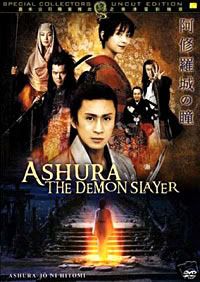
Movie Review: Ashura


Ashura-jo no Hitomi

“Ashura,” aka “Blood Gets in Your Eyes”

Japan, 2005

Genre: Action, Fantasy

119 minutes

http://www.imdb.com/title/tt0459744/

Based on a modern kabuki stage play, Ashura is a tale of romance, treachery, and violence. It is a tale about a demon-slayer who runs from his past, only to discover that it has all caught up with him.

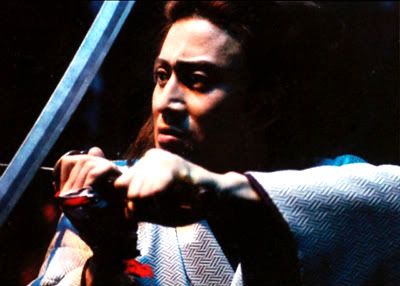
Yojiro Takita directs this adaptation of the hit kabuki play, closely following the original story in the film. This works both for and against him at times, which begs the question of his intent for the adaptation. Driven by very beautiful sets and an outstanding score, the actual performances on screen are hammed to a point of absurdity. I imagine that Takita was looking for a larger-than-life story of epic proportions, but the result ends up feeling forced. The characters are written to have depth and sympathy, but end up sounding completely different from one scene to the next, lacking a basic consistency of personality that allows the audience to identify with them. Somegoro Ichikawa’s hero is genuinely charming at times, but overall feels like he’s just playing a cardboard cutout of a heroic stereotype. While such performances might work on stage (especially kabuki, which is generally highly stylized), the film adaptation makes it more cheesy than symbolic.

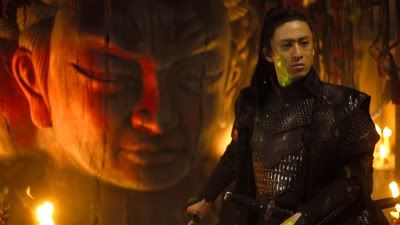
The production of the film is certainly impressive. As mentioned, the soundtrack is superb, adding life to many scenes that would otherwise have no redeeming value. The sets reveal rather clearly the stage roots of the piece, but this itself is not a fault. Many successful films make use of stylized sets or stage-style locations. However, it should be noted that the decision to do so makes the film feel very cramped, even when using exterior shots. It lacks the sense of wonder or majesty that can really only be achieved by shooting on location. Ashura also makes liberal use of digital effects to reinforce the supernatural fantasy aspects of the story. Stage performances make do with practical effects, and maintain a sense of illusion when doing so. Films, on the other hand, lose that quality with computer-generated imagery, especially with the over-the-top style used by this movie. The monsters seem intentionally fake and cartoonish, spewing fluorescent green blood upon their death. Marching forward with all the subtlety of neon rhinoceros, the look of the film is excessive and gaudy.

Selling itself as a swashbuckling adventure, the film’s fight scenes aren’t terribly done, especially when compared to other Japanese action movies like High-Kick Girl or Shinobi. Still, when looking at the fast-paced and hard-hitting choreography coming from countries from around the world, the fights feel stiff and awkward. Like the rest of the film, Ashura chooses style over substance, leaving the audience with a product indistinguishable from the sea of other C-list action movies in the video store.

Friday, July 23, 2010

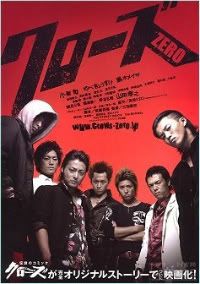
Movie Review: Crows Zero


Crows Zero

Japan, 2007

Genre: Gangster, High School

130 minutes

http://www.imdb.com/title/tt1016290/

A prequel to the manga series by Hiroshi Takahashi, Takashi Miike directs the origins of Genji’s rise to power in the ultra-violent Suzuran All-Boys High School.

In the chaotic world of Takashi’s Suzuran, a student’s worth is proved by his fists and his gang. Our protagonist, Takiya Genji, transfers to the high school in hopes of conquering it, a feat his yakuza father was unable to do decades ago. Like other yakuza and criminal films, Miike touches on themes of friendship and loyalty, the bonds between men forged in battle, and the respect given to leaders who show their strength to their followers. While the writing is rather contrived in places (in particular the repeated use of a love interest as a convenient plot point), the actors open up the space and bring the audience into the story very well. While switching back and forth between adolescent humor and dramatic tension, the cast is guilty of hamming it up in places, but it mostly goes unnoticed.

The photography of the film isn’t particularly outstanding, although there are a few truly iconic scenes. Miike does manage to capture the epic atmosphere demanded by the story, and yet keeps the camera relatively grounded, gritty enough to embrace the visceral nature of the subject matter. This works against the audience in some of the action sequences, which can become confusing before identifying characteristics are clear to the viewer. Even at the end of the film, when we’re aware of who is beating up whom (generally given away by their outlandish hairstyles), faces and identities get lost in the shuffle. Although not usually vital to understanding the story by the end, enthusiasts of fights on film may have a hard time of enjoying these pieces.

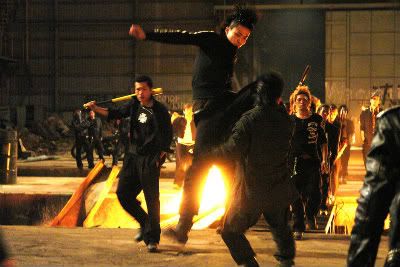
The action itself is superb, and the cinematography doesn’t always do it justice. Bordering between brutal realism and cartoonish violence, the comic book roots are clearly evident. The choreography is simple and direct; expect lots of haymakers and straight knees to the midsection. With the addition of the flashy kick or pro-wrestling throw here and there, the result ends up looking very much like a manga about violent teenagers in a comic book scrap. While not particularly elegant or fantastic like the Hong Kong style of fight scenes, Crows Zero has its own rather pleasing aesthetic, thanks in part to very impressive editing and scoring. The climax of the film shifts moods dynamically, but it fits so well that it’s almost unnoticeable.

Having never read the Crows manga, I can’t say for certain how accurate an adaptation Miike produced. However, as a piece of film on its own merits, I can say that Crows Zero is a very fun movie for comic book violence.


Friday, July 2, 2010

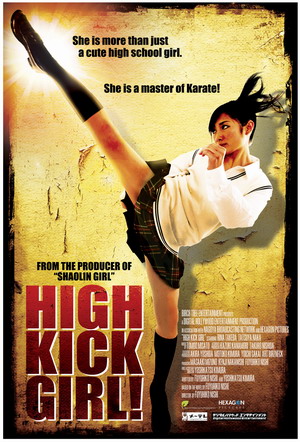
Movie Review: High-Kick Girl


High-Kick Girl

Japan, 2009

Genre: Action

81 minutes

http://www.imdb.com/title/tt1406157/

A high school girl training in karate seeks out stronger opponents to test her fighting skills on, only to become involved in a revenge plot by a gang of thugs against her master.

In addition to Hong Kong, Japan now faces stiff competition from Korea and Thailand when it comes to producing martial arts movies and martial arts superstars. High-Kick Girl introduces Rina Takeda, a young Japanese idol who holds a black belt in Ryukyu Shorin-Ryu Karate, hoping to develop her new film career into the next action franchise. However, with incredibly low standards of production quality going into this project, I would be surprised if anyone even bothers to learn the actress’s name, much less watch her next movie. With poor writing, bland performances, and altogether lackluster direction, High-Kick Girl is a boring, contrived, and visual mess, failing in just about every aspect of the genre and film-making as a whole.

The script’s pacing has no sense of drama or tension whatsoever, and none of the dialogue is captivating at all. We are thrust from one event to the next without any idea of who is important, what is happening, or why any of the characters are doing anything at all. Coupled with single-note performances by the entire cast, the movie drags on for the entire hour and twenty minutes that it spans. Normally, these sorts of things would be tolerable in an action movie, which provides the real entertainment in between the moments of bland plot forwarding. However, in the case of High-Kick Girl, the failures of production penetrate every level of the film, leaving nothing worth watching. With ridiculously excessive amounts of slow-motion, the camera work does nothing but emphasize the terrible choreography and execution by the stunt team. Often, they will repeat entire stunt sequences in slow-motion, using the exact same angle as we’ve just seen. This pointless gesture just pads the movie further and makes it obvious how little material the team actually had to work with. Removing all the slow motion and repeat cuts, the film as a whole would measure around an hour, if that.

Thematically, director/writer Fuyuhiko Nishi treads the same clichéd martial arts tropes of “self-defense and protection only” and “fighting is wrong, and is a last resort only.” However, without any affinity for the leading characters, the message falls flat and Takeda’s arc feels less like the development of self and more like an abrupt shift of personality compelled by the plot. Unless you have some massive fetish for Japanese school girls in action, there is absolutely nothing redeeming about this film. It is a disappointment as an action flic, fails as a plea for traditionalism, and lacks any impact as a cathartic work of art at all. If we are to see more of Takeda as a rising film star, hopefully it won’t be anywhere near Fuyuhiko or his team.

Saturday, March 20, 2010

The Magic of the Nippon Top Team

It's late and I can't sleep, so I've been watching fighter highlights. It doesn't usually help, but it does keep me entertained for a while. Tonight, I'm sharing with you the Nippon Top Team, a superhero group of three elite Japanese submission artists in MMA.

First is Satoru Kitaoka, former Sengoku Lightweight Champion.


While not as popular as his teammates, don't think for a second he's not dangerous. Kitaoka beat Takanori Gomi (the last Pride 155lb. king) for SRC's first Lightweight Grand Prix, submitting Clay French and Eiji Mitsuoka to get there, then beating Kazunori Yokota in a grueling decision to face Gomi for the belt. A master of Catch Wrestling and Jiu-jitsu, his favorite subs are the Guillotine, Achilles Lock, and Heel Hook.

Now we go to the small man of the group, Masazaku Imanari.


I would say that Imanari is the most dangerous of them all, simply because of his specialty in leg-locks. He is known as "Ashikan Judan," which translates to "Master of Leg-locks." For those not in the know, by the time you can feel the pain of one of those nasty subs, it's already doing terrible damage to your joints and muscles. He's the former DEEP Featherweight Champ, and current DEEP Bantamweight and Cage Rage Featherweight Champion.

And the leader of the pack, regarded as the second greatest 155lb. fighter on the planet, Shinya Aoki.


Aoki is probably the most conventional grappler of the team, if only for the fact that he goes for armbars and triangles instead of leg-locks every other round. A master of flying armlocks and the rubber guard, he's known for having absolutely no mercy for his opponents, and has broken the arms of a few competitors already. The most recent victim was Mizuto Hirota at the SRC vs. Dream event last New Year's Eve, where he broke Hirota's shoulder with a Hammerlock. The current Shooto Middleweight, WAMMA Lightweight, and Dream Lightweight World Champion, he'll be fighting Gilbert Melendez for the Strikeforce 155lb. belt to add to his impressive collection.